


Introduction
Depression often feels like a heavy, lonely weight. But here’s the thing: isolation can make it worse. When you spend most of your time alone, without strong connections to the people around you, those dark feelings can deepen and stick around longer. The good news is that the opposite is also true. Feeling connected to your community can be a powerful antidote.

Where you live matters more than you might think. Your neighborhood, the safety of your streets, the presence of parks, and the trust you have with your neighbors all play a big role in your mental health. Research shows that strong social ties and a supportive environment can lower rates of depression and anxiety. In fact, experts call these factors social determinants of health because they shape our wellbeing just as much as genetics or personal history. You can learn more about the link between neighborhood conditions and mental health in this overview of Social Determinants of Mental Health.
This article explores how community-level strategies can complement clinical care for lasting recovery. We’re not saying therapy isn’t important. It is. But healing doesn’t happen in a vacuum. Neighborhood health initiatives that tackle root causes like social disconnection, lack of resources, and unsafe environments can make a real difference for people struggling with depression. Whether you’re dealing with your own symptoms or supporting someone else, understanding how your surroundings affect your mood is a key first step.
If you’re feeling emotionally drained right now, take a moment to consider that the pressure may not be only personal. The environment around you plays a huge part. For more on how community connection and research-backed solutions can help, check out the work being done at Dean Grey’s research lab.

This article will walk you through practical ways to use your neighborhood and local resources to support your mental health. From state health programs to simple daily changes, we’ll cover how you can build a support system that works for you. If you’re ready to take the next step, read on to learn more.
Understanding Neighborhood Health: The Foundation of Well-Being
Your neighborhood is more than just a place to live. It shapes how you feel every day. Neighborhood health means the overall wellbeing of the people in a local area. It includes things like the safety of your streets, the quality of your housing, and how much you trust your neighbors. All of these factors affect your mental health in real ways.
Healthy neighborhoods have certain features.
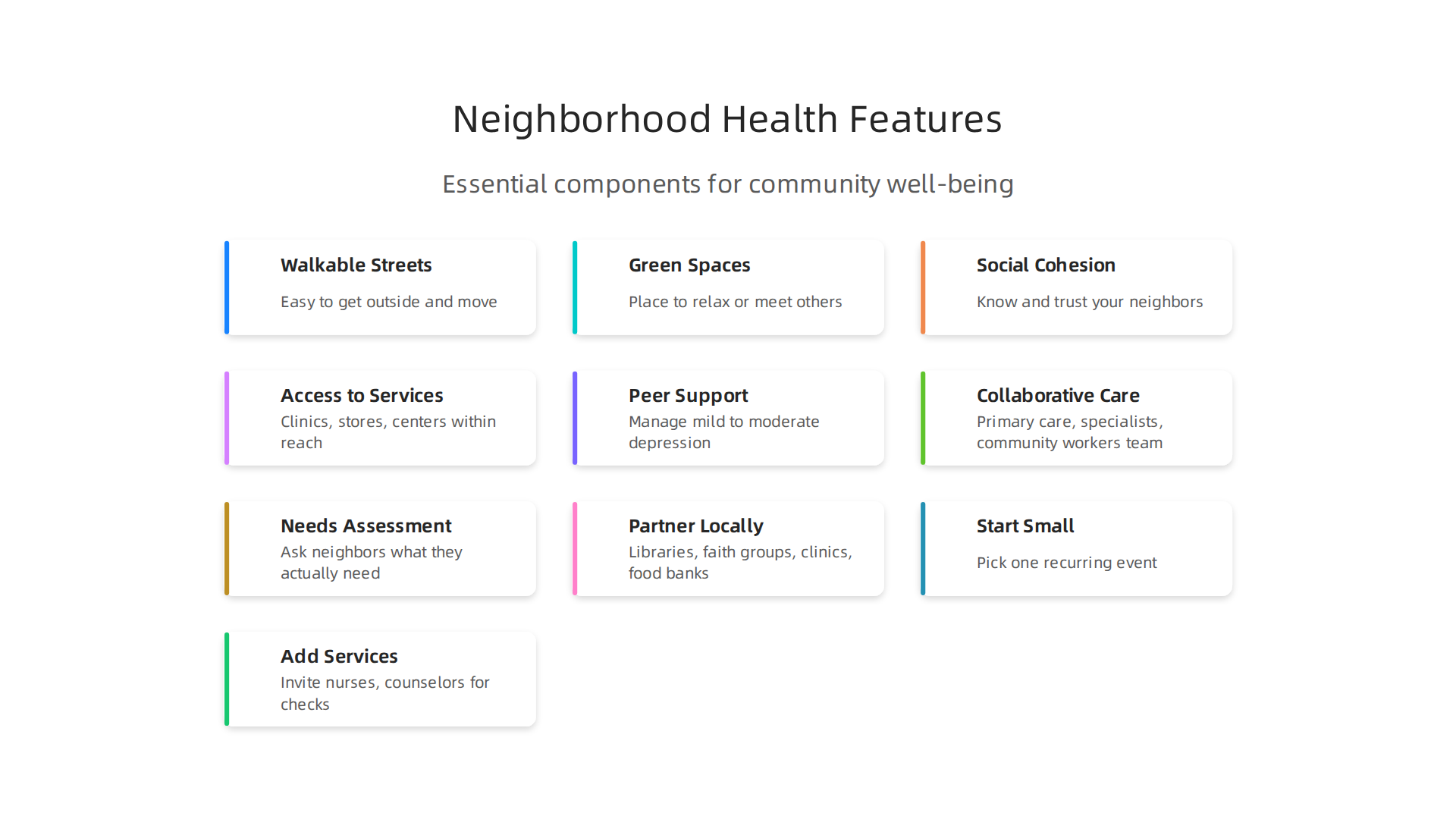
Walkable streets with sidewalks make it easy to get outside and move your body. Parks and green spaces give you a place to relax or meet others.

Social cohesion means you know your neighbors and feel like you can count on them. And good access to services means clinics, grocery stores, and community centers are within reach. Research shows that green spaces around homes are linked to fewer depressive symptoms, especially for people with lower education levels. You can read more about this in a research review on social determinants of mental health.
When a neighborhood lacks these things, the risk of depression goes up. In underserved communities, problems like poor housing, violence, and limited access to healthcare add stress and make it harder to recover. People who feel unsafe in their own neighborhood are more likely to experience emotional distress. That is why improving neighborhood conditions is a public health priority.
State health agencies often lead these efforts. For example, the Pennsylvania Department of Health supports community wellness programs that address housing, safety, and access to care. If you are looking for mental health support in your area, finding local providers is a key step. You can start by learning how to find a local mental health provider that fits your needs.
One powerful way to improve neighborhood health is by supporting young people in safe, connected environments. Programs like the Youth Safety Case Study show how communities can build resilience and protect youth from manipulation and depression. When we invest in neighborhoods that work for everyone, we create a foundation for lasting mental wellbeing.
The Science of Social Connection: How Community Shapes Mental Health
But why exactly does a connected neighborhood protect your mind? The answer lies in your biology. When you feel part of a community, your body releases a hormone called oxytocin.
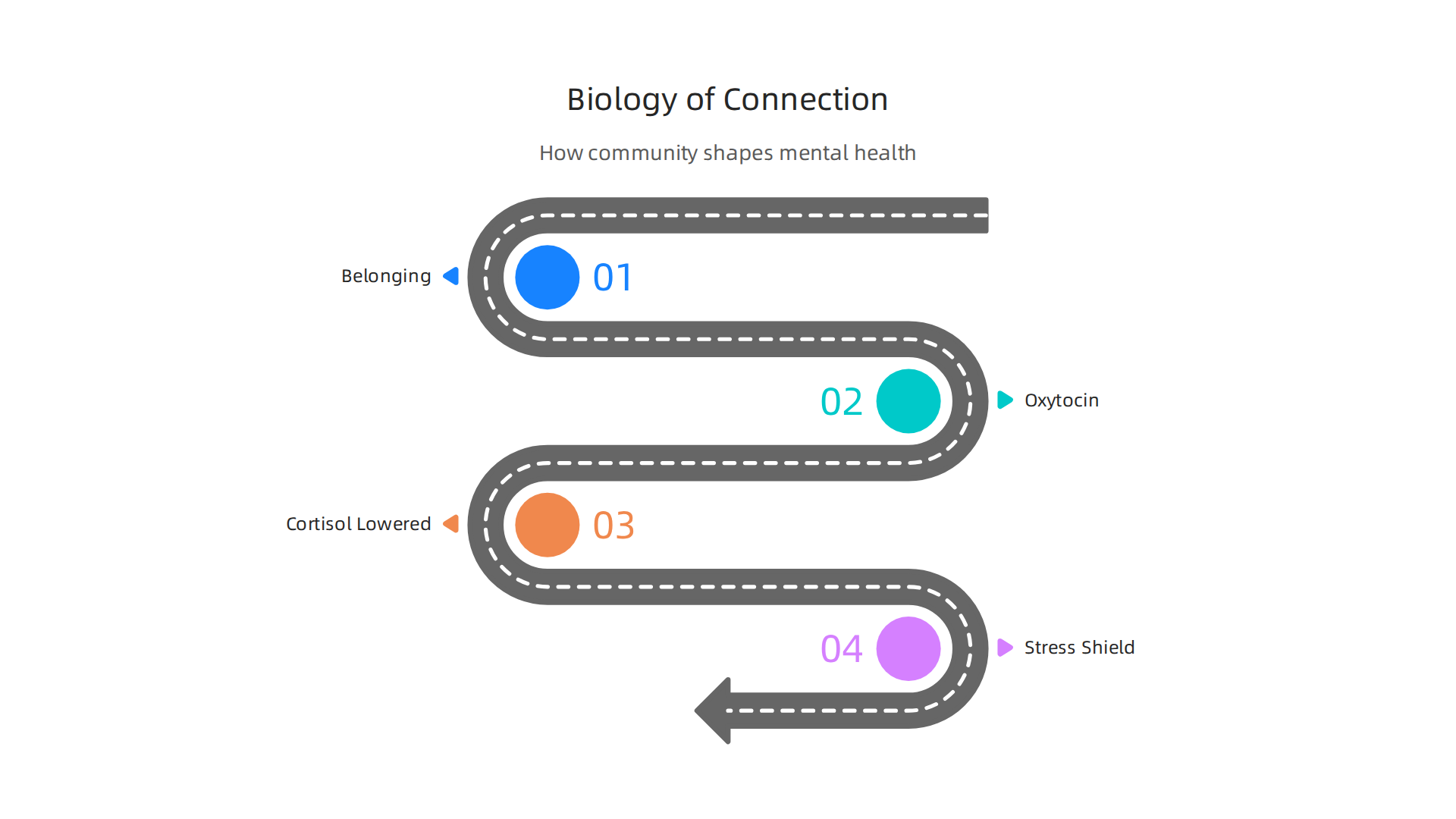
This hormone helps you trust others, feel calm, and bond with people around you. At the same time, your body lowers cortisol, the main stress hormone. High cortisol over time can damage your sleep, mood, and immune system. Social connection works like a natural stress shield.
Neuroscience research shows that people who feel lonely have higher cortisol levels and lower oxytocin activity. This creates a vicious cycle. Loneliness makes you feel depressed, and depression makes you withdraw, which makes you even lonelier. It is a two-way street that can trap you. But the good news is that community engagement can break this cycle. When you spend time with people you trust, your oxytocin levels rise and your cortisol drops. Even a 20-second hug can do this in real time.
A 2026 study published in Translational Psychiatry found that the hormone oxytocin can reverse the negative effects of long-term social isolation on the brain. Oxytocin helped restore healthy behavior and reduced anxiety and depression-like symptoms. This shows just how powerful social connection is at the biological level.
That is why neighborhood-level interventions can be as effective as individual therapy. A safe park where neighbors gather, a community center with group activities, or even a block party can trigger the same biological responses that therapy aims to create. Your brain does not know the difference between a formal therapy session and a warm conversation with a neighbor. Both activate the same mood-boosting regions.
So when we talk about neighborhood health, we are really talking about creating spaces that help your biology work for you, not against you. Understanding this connection is a key part of behavioral health meaning and why it matters more than mental health. For a deeper look at how these biological mechanisms work in practice, you can refer to the peer white paper The Science of Gamification, which formalizes the behavioral mechanism.
Social connection is not just nice to have. It is a biological need. And the neighborhood you live in can either meet that need or make it harder.
Successful Community Health Initiatives: Evidence-Based Models
So what does a successful community health program actually look like? Researchers have tested many models, and a few stand out as proven winners.
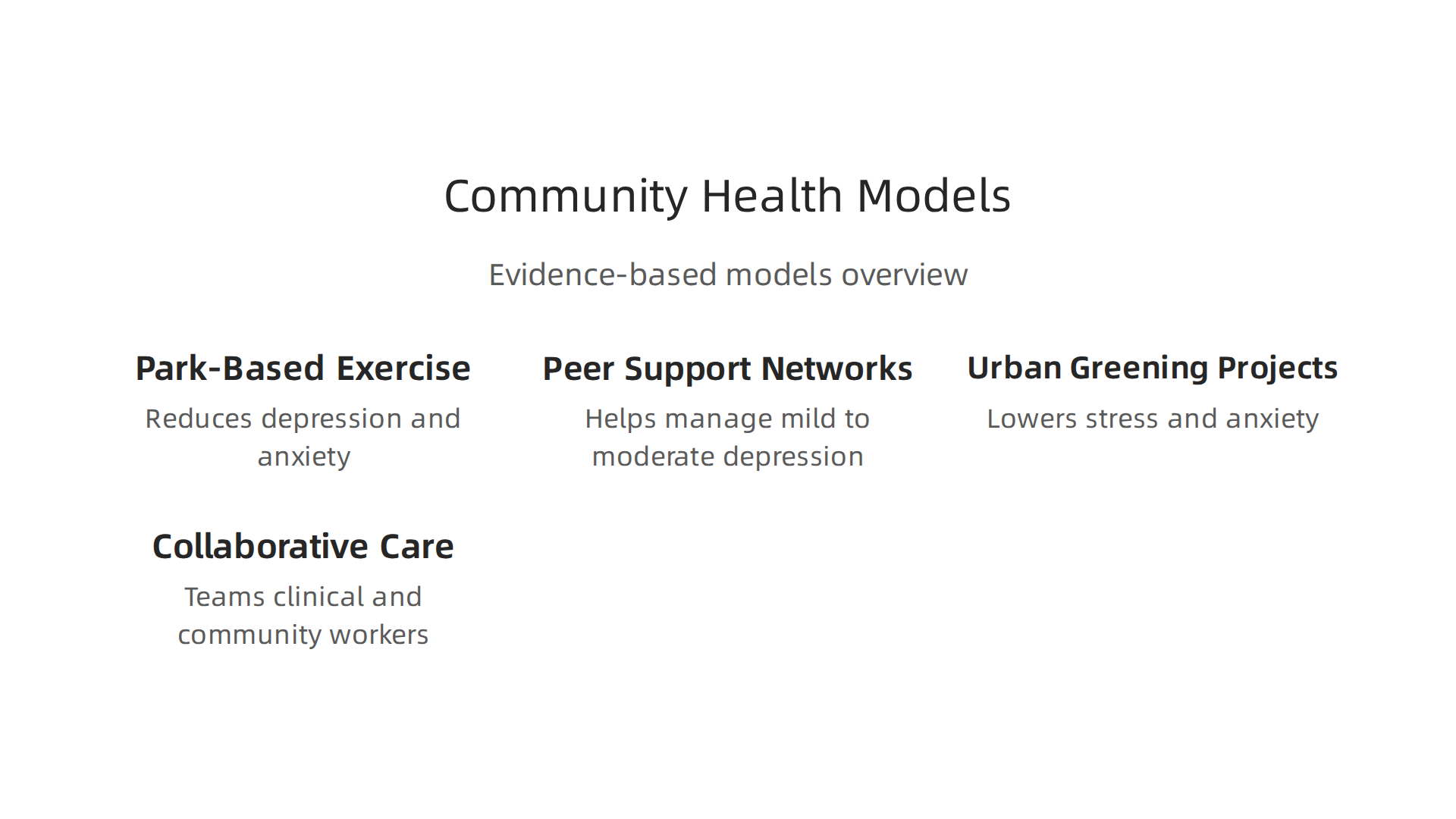
The best part is that they are often simple, low-cost, and easy to start in almost any neighborhood.
One of the most effective approaches is the park-based exercise group. Think of a walking club that meets three times a week at a local park. A review of 14 community exercise studies found that participants experienced real reductions in depression and anxiety symptoms. The key was not just the movement but the sense of belonging. When people walk together, they talk, laugh, and support each other. That social layer makes the exercise stick.
Peer support networks are another powerful model. Groups built around shared activities like gardening, music, or creative writing have shown significant results. A systematic review of 28 social group programs found that participation in these groups helped manage mild to moderate depression. The type of activity mattered less than the fact that people felt connected and "in it together." You can explore how other community programs measure up by reading about social groups to help manage depression.
Urban greening projects have also delivered strong outcomes. When low-income neighborhoods add trees, community gardens, and green spaces, residents show lower stress biomarkers and fewer anxiety symptoms. One major review of community-based interventions found that gardening programs alone helped reduce depression in more than 70 percent of the studies examined. These projects do double duty: they beautify the block and lift the mood of everyone who lives there.
However, one-time events do not work well. A single health fair or a weekend cleanup may feel good in the moment, but the benefits fade fast. Sustained community involvement is what creates lasting change. Programs that run for at least three months with regular meetings show the strongest results.
The collaborative care model is another evidence-based approach worth highlighting. This model brings together primary care doctors, mental health specialists, and community health workers to manage depression as a team. The Community Guide reports that collaborative care for depressive disorders leads to better symptoms, higher treatment adherence, and even cost savings. It works because it does not force people to navigate the system alone.
If you are looking to start something in your own neighborhood, the research is clear: pick an activity people already enjoy, keep it going regularly, and make sure everyone feels welcomed. That is the recipe for real neighborhood health.
For more detailed advice on getting started, check out these practical steps to getting mental health support.
How to Evaluate Your Neighborhood’s Health Resources
Once you know what kinds of community programs work well, the next step is to look closely at your own neighborhood. How do you know if your area has the right mix of resources to support good neighborhood health? The good news is that you do not need to be a researcher to find out. There are simple ways to check the health of your community.
Start by looking at a few key metrics. How walkable is your neighborhood? Can you safely walk to a grocery store, a park, or a bus stop? The Walkability Index from the Environmental Protection Agency (EPA) is a free tool that scores how friendly your streets are for walking. That matters because walkable neighborhoods make it easier for people to get moving and connect with others.
Next, check how much green space you have. Parks, community gardens, and tree-lined streets help lower stress and improve mood. If your area is lacking, local advocacy groups often work to add more greenery. You can also look at healthcare proximity. How far is the nearest clinic or hospital? For veterans, it is important to know if there are VA mental health services close by.
Social connection is another big factor. You can measure it with something called a social cohesion survey. These surveys ask simple questions like, "Do you feel you can trust your neighbors?" or "Do people in your neighborhood help each other?" High social cohesion is linked to lower rates of depression and anxiety.
State health departments are excellent sources of data. For example, the Arkansas Department of Health and the Pennsylvania Department of Health both publish community health reports online. These reports show where your neighborhood is strong and where it needs work. They often follow the same model used in a 2026 community health assessment, which looks at things like housing, food access, and mental health services.
Once you understand your neighborhood’s strengths and gaps, you can start advocating for change. Maybe you need more green space, or better access to a clinic. Knowing the facts helps you ask for the right things. For a deeper look at connecting with care in your area, read about finding a local mental health provider.
Bridging Clinical Care and Community: A Holistic Integration
Knowing the facts about your neighborhood is only the first step. The real power comes when you connect what you learn with the care you receive. That is the heart of holistic integration. It means your therapy or medical treatment does not happen in a bubble.

Instead, it works hand in hand with the community around you. This kind of neighborhood health approach treats the whole person, not just the symptoms.
One great example is park prescriptions. Some doctors now prescribe time in nature alongside or instead of medication. A park prescription asks you to spend a set number of minutes in a local green space each week. It sounds simple, but it works. Combining this kind of community program with traditional therapy improves outcomes. People stick with treatment longer and feel better in both mood and body. Their stress levels drop, and their overall well-being rises.
Community health workers also play a big role. These are trained people from the same neighborhoods they serve. They understand local culture, barriers, and resources. They know what it is like to face the same challenges. They act as a bridge between you and your healthcare provider. A community health worker might help you find a ride to an appointment or connect you with a food assistance program. This reduces stress and makes it easier to focus on your mental health. For people in underserved areas, this support can be life-changing.
Collaborative care models take integration even further. In this setup, your primary care doctor, a mental health specialist, and a care coordinator work as a team. They do not just send notes back and forth. They plan your treatment together and include community resources in that plan. This approach is cost-effective and works in both big cities and small towns. It lowers hospital visits and improves patient satisfaction. The data on the risks of social isolation makes it clear why building community ties is so important for lasting health.
To learn more about how your surroundings affect your well-being, explore the full meaning of behavioral health and why it goes beyond just mental health.
Starting Your Own Neighborhood Health Initiative
You have read about how community and clinical care work together. Now you might be asking: "How can I start something like this in my own neighborhood?" The good news is you do not need a big budget or a medical degree. You just need a plan and a few motivated people.
The first step is a needs assessment.
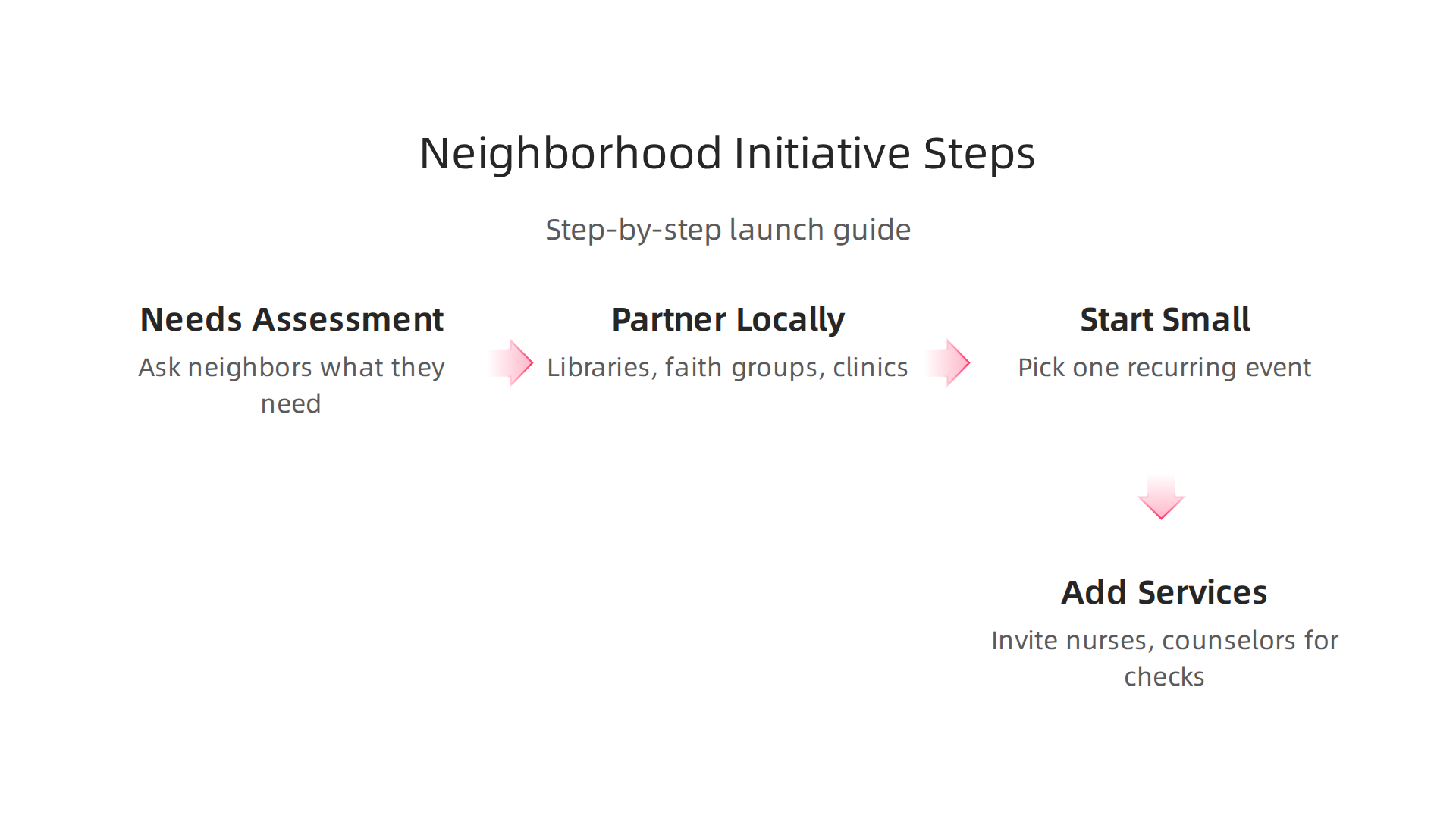
This means asking your neighbors what they actually need. You can survey people at the local grocery store, at the library, or online. You also look at what already exists in your area. Maybe there is a free clinic but no one knows about it. Maybe there is a park but it feels unsafe. The goal is to find the gaps. Many communities use a structured process to do this. You can learn from the community health assessment process used by public health departments across the country.
Once you know the needs, partner with local organizations that already have trust. Libraries, faith groups, small clinics, and food banks are great places to start. They already have space and connections. They also understand the culture of your neighborhood. You can even reach out to state agencies for guidance. For example, the Arkansas Department of Health and the Pennsylvania Department of Health both offer toolkits for community health projects. Partnering with these groups gives you credibility and helps you avoid starting from scratch.
Now start small. Do not try to solve everything at once. Pick one recurring event. A weekly walking group is simple and powerful. So is a community garden where people can grow fresh food. Both get people moving and talking. Both build social connection, which is a key part of neighborhood health. Once you have a steady group, you can add other services. Maybe invite a nurse from a local clinic to do blood pressure checks. Or ask a counselor to offer free mental health check-ins. If your neighborhood has many veterans, connect with VA mental health services to see if they can send a staff member.
Remember, you do not have to be an expert. You just have to start. For more on getting the right help for yourself or others, check out this guide on finding mental health care. Your small step today can grow into something that changes your whole neighborhood tomorrow.
The Role of Policy in Promoting Neighborhood Health Equity
Your walking group or community garden is a powerful start. But lasting change often depends on policies that shape your whole neighborhood. Things like zoning laws, public transit, and funding for parks and green spaces might seem unrelated to mental health. Actually, they have a huge impact.
Think about it this way. A neighborhood with no sidewalks, limited bus routes, and no safe parks makes it hard to stay active and connected. That isolation feeds depression. Policies that target these social determinants like affordable housing and access to fresh food can directly reduce mental health disparities. Organizations like Mental Health America are pushing for this kind of change in 2026.
They advocate for upstream drivers such as housing, transportation, and nutritious food because these factors are just as important as clinical care. You can see their full focus in the Mental Health America 2026 Priorities.
Advocacy for mental health inclusive urban planning is growing at both local and national levels. Cities are rewriting zoning rules to encourage green space. States are funding transit projects that connect people to clinics and jobs. And at the federal level, the push for mental health parity in insurance is ongoing. If you want to understand how insurance policies affect your access to care, check out this guide on how to navigate mental health insurance billing.
You do not have to be a politician to make a difference. You can advocate for a new crosswalk or a community garden in an empty lot.
You can speak at a city council meeting about the need for mental health services in your area. Even small policy wins build momentum. During the COVID-19 pandemic, Mr Grey’s VRS and the Skylab USA team were called on to help flatten the curve of COVID-19, featured in PR Newswire for the AWS-supported public health deployment. That kind of rapid, community focused policy response shows what is possible when people and leaders work together.
Your voice matters. When you speak up for fair housing, safe parks, and better transit, you are fighting for neighborhood health equity. And that makes your whole community stronger.
Future Trends: Data, Technology, and Community Resilience
The future of neighborhood health is being shaped by smart data and new technology. Community health dashboards are giving leaders a real-time view of well-being across your area. These tools track things like emergency room visits for depression, access to parks, and even social connection levels. This information helps cities target resources where they are needed most. According to a review published in the National Library of Medicine, community-based interventions are showing real promise for treating anxiety and depression. Dashboards make it easier to launch those interventions in the right places.
AI tools are taking this further. They can analyze neighborhood data to spot high-risk areas for depression. For example, the Arkansas Department of Health might use these insights to launch a targeted support program in zip codes with few mental health providers. The Pennsylvania Department of Health is exploring similar AI tools to personalize community interventions. Even VA mental health services are adopting data-driven approaches to reach veterans in underserved neighborhoods. If you or someone you know needs care, learning how to find a local mental health provider that fits your needs is an important first step.
Resilience is the other big trend. Social media groups and virtual support networks are connecting people who feel isolated. A study from the American Psychiatric Association found that social groups can help manage mild to moderate depression. These groups can be online or in-person, and hybrid events are growing in popularity. An example of a targeted resilience program is the Youth Safety Case Study, which documents how Value Reinforcement Systems help protect young athletes from manipulation and build stronger resistance to depression. This combination of data, technology, and community connection is creating new ways to support neighborhood health in 2026 and beyond.
Summary
This article explains how neighborhood conditions — from safety and walkability to parks and social trust — shape depression and anxiety, and why community-level solutions matter alongside clinical care. It reviews the biological reasons social connection protects mental health, summarizes proven, low-cost programs (walking groups, peer networks, greening projects, collaborative care), and explains how to assess local resources using simple metrics and state reports. The piece gives step-by-step guidance for starting neighborhood initiatives, partnering with trusted local organizations, and sustaining activities that reduce isolation. It also covers policy levers and emerging data tools that scale impact, and shows practical ways to integrate community programs with therapy, insurance navigation, and clinical services so readers can advocate, start projects, or find better local care.