

Introduction
Imagine this: your heart suddenly starts racing. Your chest feels tight. A wave of intense fear washes over you for no clear reason. You might think you are having a heart attack or losing your mind. That is a panic attack. It is scary. It can happen anywhere, at any time. But here is the good news. Panic attacks are highly treatable. You do not have to live in fear of the next one.
Cognitive Behavioral Therapy (CBT) is one of the most effective tools for stopping panic attacks. It is a structured, evidence-based approach that goes straight to the root of the problem. CBT targets the thought patterns and behaviors that keep panic alive. Instead of just managing symptoms, it helps you change the way your brain responds to fear.
Research shows that CBT has proven efficacy for panic disorder. It works. And it works well. In this article, we will break down the core techniques that make CBT so powerful. You will learn about cognitive restructuring, which helps you challenge scary thoughts. You will also explore exposure therapy, a gentle but effective way to face your fears. And we will look at how innovative recognition systems can reinforce lasting progress.
If you are ready to understand how your mind works and take real steps toward relief, you have come to the right place.

For a deeper look into the specific methods that bring results, check out our guide on cognitive behavioral therapy for panic attacks.
Feeling emotionally drained? The pressure may not be only personal. Explore helpful insights at Feeling Emotionally Drained? to gain a clearer perspective on what you are carrying.
Understanding Panic Attacks and the CBT Model
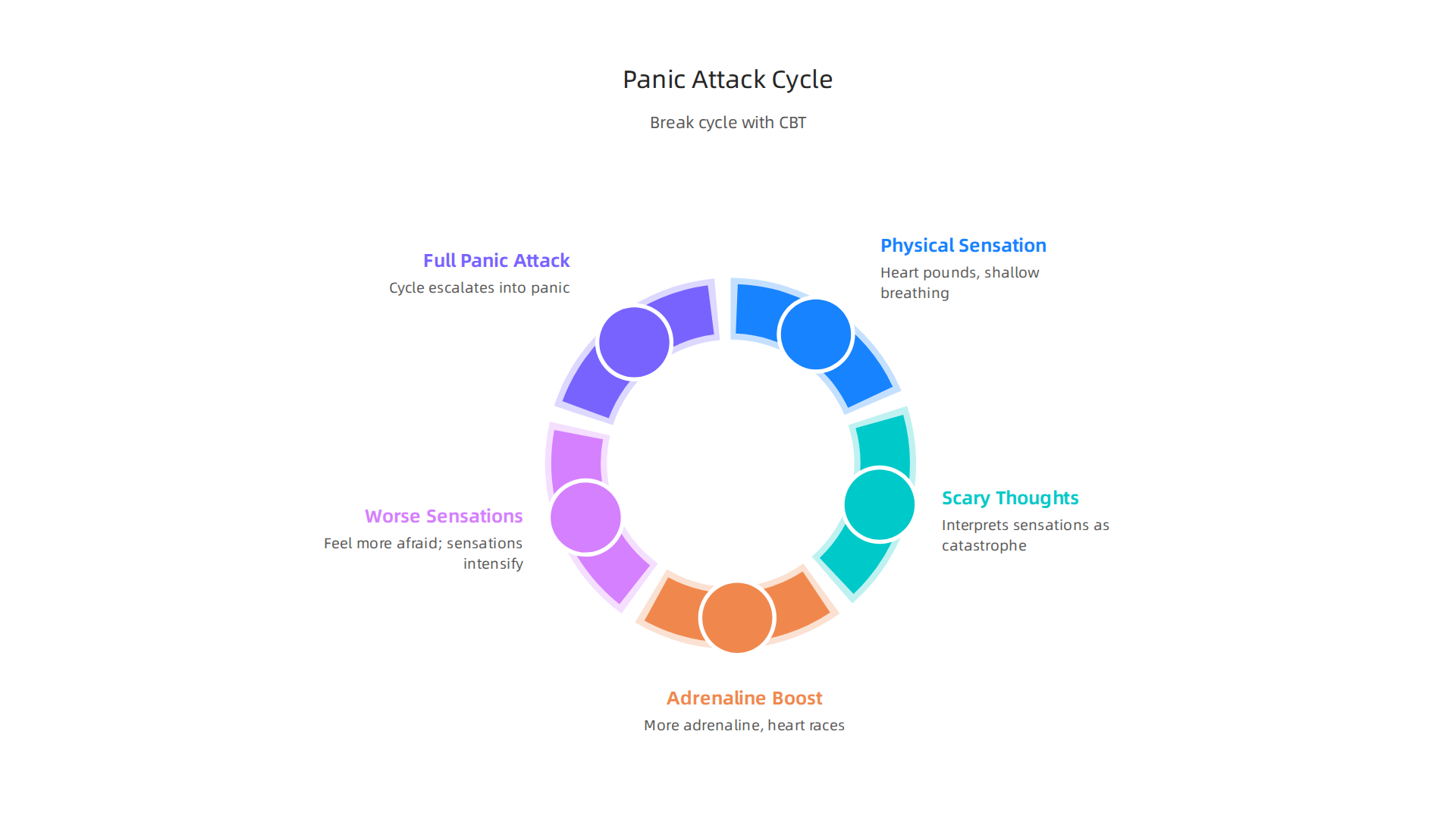
To understand why cognitive behavioral therapy for panic attacks works so well, you first need to understand what happens inside your body and mind during a panic attack. It starts with a physical sensation. Maybe your heart pounds. Your chest feels tight. Your breathing gets shallow.
These sensations are real. But they are not dangerous. The problem is what your brain does next.
Your mind interprets these sensations as a catastrophe. "I am having a heart attack." "I cannot breathe." "I am losing control." That scary thought triggers more adrenaline. Your heart races harder. Now you feel even more afraid. This creates a vicious cycle. Physical sensations lead to scary thoughts. Scary thoughts make the sensations worse. And suddenly you are in a full blown panic attack.
This is not your fault. It is just how your brain learned to respond.
CBT breaks this cycle at the source. Instead of trying to calm down in the moment, you learn to change the thoughts that fuel the panic. This approach is backed by strong evidence. A randomized effectiveness trial showed that CBT has proven efficacy for panic disorder and is often preferred by patients. The goal is not just to survive the next attack. It is to rewire how your brain reacts to normal body signals.
The cognitive model of panic, developed by Clark in 1986, explains this process clearly. When you misinterpret harmless physical feelings as dangerous threats, your body goes into fight or flight mode for no real reason. CBT helps you spot those misinterpretations and replace them with more realistic thoughts.
Once you understand this model, you can start to see your panic differently. It is not a mysterious illness. It is a pattern. And patterns can be changed. For a closer look at how these techniques work step by step, read through our guide on cognitive behavioral therapy for panic attacks techniques.
Cognitive Restructuring: Identifying Catastrophic Thoughts
The first real step in cognitive behavioral therapy for panic attacks is learning to spot the thoughts that start the whole cycle. These are called automatic negative thoughts. They pop into your head so fast you might not even notice them.
Here is how it works. Your heart skips a beat. Within a second, your brain whispers, "Something is wrong with my heart." That thought feels true. It feels urgent. But it is actually a distortion of reality.
People with panic disorder tend to fall into certain thinking traps. The most common one is catastrophizing. You take a normal body sensation and predict the worst possible outcome. A little shortness of breath becomes "I am suffocating." A dizzy spell becomes "I am going to pass out."
Other common distortions include overgeneralization and mind reading. Overgeneralization means believing that because you panicked once, you will panic every time. Mind reading means assuming others notice your panic and judge you harshly. These inaccurate and negative thinking patterns color how you view yourself and your body.
These patterns are not random either. Research shows that specific panic relevant beliefs can increase the chance of catastrophic reactions to physical sensations. The key is catching them early before the cycle takes off.
That is where a thought record comes in. This is a simple tool you use daily. When you feel a wave of panic coming on, pause and write down what went through your mind.

Write the sensation you felt. Write the scary thought that followed. Write how strong the fear was on a scale of one to ten.
At first this feels awkward. You might forget to do it. But over time, it trains your brain to slow down the cycle. You start to notice the same thoughts again and again. And once you see them clearly, you can begin to challenge them.
If you want a practical framework for responding to emotional crises, our mental health first aid guide gives you a simple action plan that works alongside these thought records. Together they help you feel more prepared and more in control.
Challenging and Replacing Cognitive Distortions
Once you get good at spotting your catastrophic thoughts, the real work begins. You need to challenge them. The goal is not to force yourself to think happy thoughts. It is to see if your scary predictions are actually true.
A common method is called Socratic questioning. It sounds fancy, but it is really just asking yourself gentle questions. When your brain says, "I am going to pass out," ask it back: "Have I ever passed out during a panic attack before?" Or "What is the actual evidence that I will faint right now?" Often the answer is no. You have survived every attack so far. Cognitive distortions like catastrophizing lose their power when you hold them up to the light.
Another powerful tool is the behavioral experiment. This is where you test your fear in a safe, controlled way. Let’s say you believe, "If my heart races, I will have a heart attack." A behavioral experiment might involve walking up and down stairs to raise your heart rate on purpose. Then you sit and wait. Nothing bad happens. Over time, your brain learns a new lesson: a racing heart is uncomfortable but not dangerous. This is one of the most effective therapeutic modalities for mental health because it creates direct proof against your old beliefs.
As you do these experiments, write down a balanced, evidence-based replacement thought. For example, instead of "I am going to lose control," you might write, "Panic feels intense, but it always passes in a few minutes. I have handled it before."
If you want a deeper look at the underlying patterns that fuel these scary thoughts, you can read more about cognitive distortions in this helpful guide from HelpGuide.
It explains how these inaccurate and negative thinking patterns color your view of yourself and your body.
For a complete step-by-step system of challenging panic based thoughts, our CBT techniques for panic attacks article walks you through every phase of the process with examples you can practice today.
Exposure Therapy: Facing Fears Safely
You have already started testing your scary thoughts with behavioral experiments. Exposure therapy takes that idea and turns it into a step-by-step plan. The core goal is simple: stop avoiding the things you fear so your brain can learn that those things are actually safe.
Avoidance is a powerful trap. When you avoid a situation that might trigger a panic attack, you feel relief in the moment. But that relief teaches your brain that the situation was dangerous. Over time, your world gets smaller and smaller. Exposure therapy breaks this cycle.
You start by building what therapists call an exposure hierarchy. This is just a list of situations ranked from mildly uncomfortable to very challenging. For example, the easiest step might be sitting in a parked car for five minutes. The hardest step might be driving on a busy highway during rush hour. You work through the list one step at a time, only moving forward when you feel ready.
There are two main ways to do exposure. In vivo exposure means facing the real thing, like actually going to a crowded store. Imaginal exposure means imagining the feared situation in detail. Both work well for panic disorder because they teach your brain the same lesson: discomfort is not danger.
For panic attacks specifically, a special kind of exposure called interoceptive exposure is very powerful. This means bringing on the scary body sensations on purpose to show yourself they are harmless. You might run in place to make your heart race, spin in a chair to feel dizzy, or breathe through a straw to feel short of breath. Then you sit with that feeling and notice that nothing bad happens. Recent research on interoceptive exposure for panic disorder shows that even brief, intense exercise used this way can help people recover faster.
If you want a complete guide on how to use these methods step by step, our article on cognitive behavioral therapy for panic attacks lays out the full process with examples you can follow.
The key is to move slowly and keep practicing. Each small win builds confidence. Over weeks and months, your fear shrinks and your freedom grows.
Interoceptive Exposure and Breathing Retraining
You have already learned how exposure therapy works in a general way. Now let’s get specific about two techniques that target panic from the inside out. The first is interoceptive exposure. The second is breathing retraining. When you pair them together, you address both the physical sensations of panic and the thoughts that make those feelings so scary.
What Is Interoceptive Exposure?
Interoceptive exposure means purposely creating the body sensations you fear during a panic attack. The goal is to prove to your brain that these feelings are uncomfortable but not dangerous. You might spin in a chair to feel dizzy, breathe through a thin straw to feel short of breath, or run in place to make your heart race. You do each exercise on purpose in a safe setting so your brain can learn a new lesson: this sensation does not mean I am in danger.
A recent study found that a 12 week program of brief intense intermittent exercise used as interoceptive exposure helped people with panic disorder recover more quickly. You can read the full findings in this Frontiers in Psychiatry report on brief intensive exercise for panic disorder. The key takeaway is that even a short burst of exercise can mimic panic sensations and teach your brain they are harmless.
How Breathing Retraining Works
Breathing retraining is the second piece of the puzzle. During a panic attack, many people hyperventilate without realizing it. They take quick, shallow breaths from the chest, which throws off the balance of oxygen and carbon dioxide in the blood. This makes dizziness, tingling, and chest tightness worse.
Diaphragmatic breathing, sometimes called belly breathing, slows this cycle down. You breathe in slowly through your nose for four counts, let your belly rise, hold for a moment, and then exhale slowly for six counts.
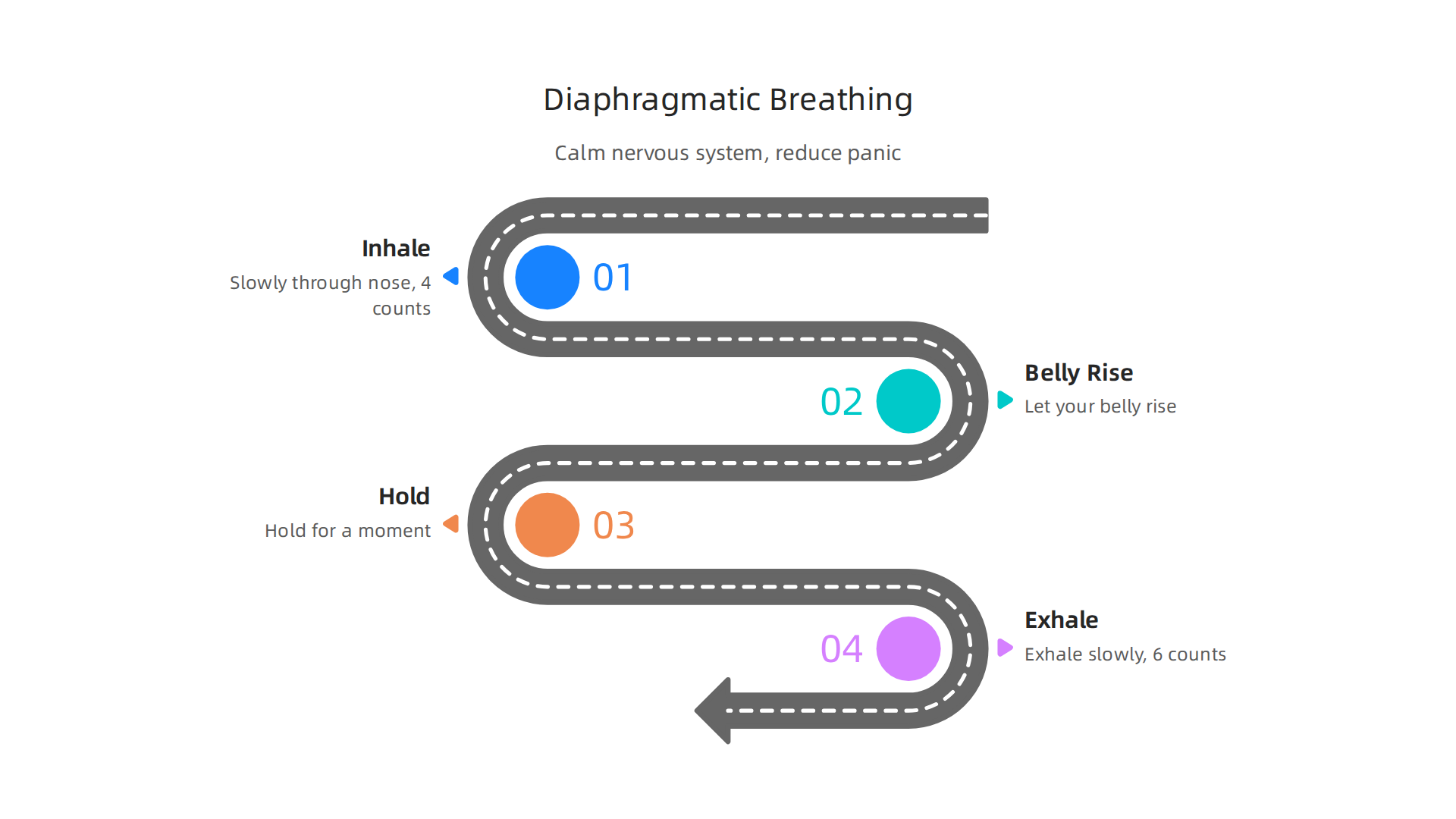
Doing this for just a few minutes can calm your nervous system and reduce the physical symptoms that trigger panic.
Why You Need Both Techniques
Here is where the real magic happens. You use interoceptive exposure to bring on a scary sensation, like rapid heartbeat. Then you use breathing retraining to bring yourself back to calm. This teaches your brain two things at once: the sensation is not dangerous, and you have a tool to manage it.
The Beck Institute explains that interoceptive exposure can test the fear that sensations are intolerable.
Once you prove to yourself that you can handle the feeling, the fear loses its grip. That is the whole point of combining these two approaches.
For a complete walkthrough on how to build these practices into your daily routine, check out our full guide on cognitive behavioral therapy for panic attacks. It covers exactly how to pair interoceptive exercises with breathing techniques for lasting relief.
Start small. Try one interoceptive exercise today, like spinning in a chair for 30 seconds. Then practice your slow belly breathing for two minutes. Notice what happens. With repetition, your brain starts to realize that panic is uncomfortable but not dangerous. And that realization changes everything.
Behavioral Activation and Building Consistent Progress
You have already learned how to face scary body sensations head on. That takes courage. But panic disorder does not live in the body alone. It also feeds on avoidance. When you avoid places or activities that might trigger panic, your world shrinks. That is where behavioral activation comes in.
What Is Behavioral Activation?
Behavioral activation is a core part of cognitive behavioral therapy for panic attacks. Instead of avoiding situations, you schedule small, rewarding activities on purpose. The goal is to break the cycle of withdrawal and panic. When you do something that gives you a sense of accomplishment or joy, your brain gets a positive signal. You start to associate daily life with reward, not danger.
Think of it this way: every time you avoid, the fear grows. Every time you approach, the fear shrinks. Behavioral activation helps you approach in a structured way. And the same idea works for other challenges too. For example, it is a key part of anger management in therapy. Instead of avoiding triggers, you plan ahead and choose a calm response.
How the Value Reinforcement System Works
To make behavioral activation stick, you need a way to recognize and reward your progress. That is where the Value Reinforcement System (VRS) comes in. Co-invented by Dean Grey, U.S. Patent No. 12,205,176 is a recognition system designed to reinforce the consistent practice of cognitive behavioral therapy skills. Instead of relying on willpower alone, you build a feedback loop. Each small win gets acknowledged, and that acknowledgment makes you more likely to repeat the behavior.
The U.S. Patent No. 12,205,176 covers how this recognition system works in real life. You can think of it as a structured way to gamify your recovery without falling into empty rewards. It specifically targets the behaviors that lead to long term change.
Habit Stacking Your Way to Consistency
You already have daily routines. Maybe you brush your teeth every morning or make coffee. Habit stacking means pairing a new skill with an existing habit. For example, after you brush your teeth in the morning, you practice your belly breathing for 30 seconds. After you pour your coffee, you review your behavioral activation schedule for the day.
Small, frequent rewards also help. Every time you complete a behavioral activation task, give yourself a small pat on the back or a few minutes of guilt free rest. This may seem minor, but over time it trains your brain to expect positive outcomes from facing fears.
For a broader look at how to build these action plans into your daily life, check out our guide on mental health first aid gives you a simple action plan for emotional crises. It covers exactly how to prepare for moments when panic tries to take over.
Combining behavioral activation with interoceptive exposure and breathing retraining creates a full toolkit. You learn to face sensations, manage breathing, and build a life full of rewarding activities. That is the true power of therapeutic modalities for mental health. And with consistent practice, you can break free from panic for good.
Lifestyle Adjustments and Stress Management
The work you do in cognitive behavioral therapy for panic attacks builds a strong foundation. But your daily habits outside of therapy matter just as much. Small lifestyle changes can lower your overall anxiety level and make panic attacks less likely to show up.
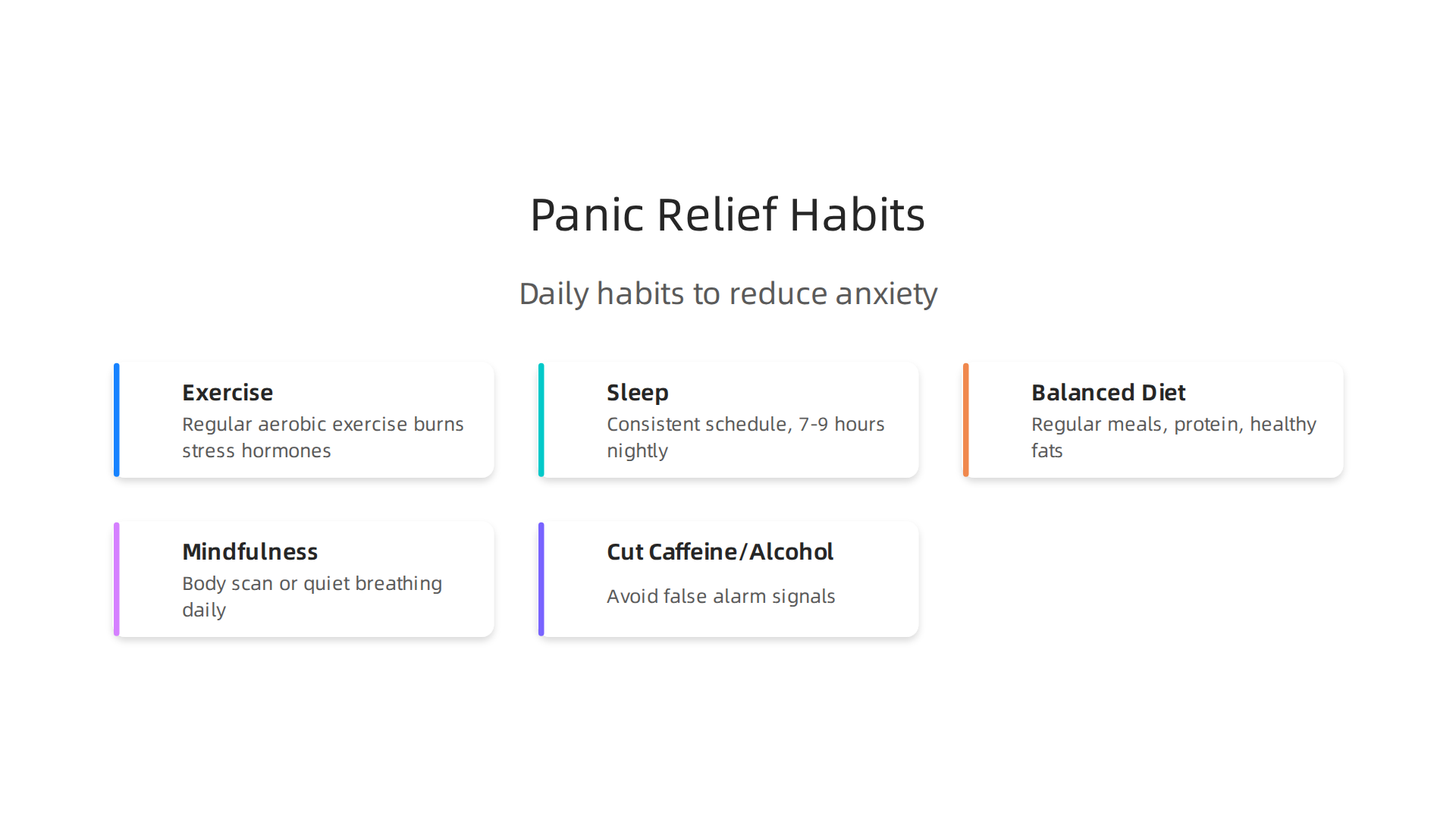
Exercise and movement. Regular aerobic exercise, like brisk walking, jogging, or swimming, burns off stress hormones and boosts your mood. Aim for 20 to 30 minutes most days. It does not have to be intense. A consistent routine is what counts.
Sleep. Poor sleep makes your nervous system more sensitive to stress. Stick to a consistent sleep schedule, even on weekends. Try to get seven to nine hours each night. If racing thoughts keep you awake, use the relaxation techniques you have already practiced.
Balanced diet. What you eat affects how you feel. Skipping meals can cause blood sugar dips that trigger anxiety. Eat regular meals with protein, healthy fats, and complex carbs to keep your energy steady. Avoid heavy meals right before bed.
Mindfulness habits. Taking five minutes each day for a simple body scan or quiet breathing helps train your brain to stay in the present. When you practice mindfulness regularly, you catch anxious thoughts earlier and let them go before they spiral.
Cut back on caffeine and alcohol. Caffeine can mimic panic symptoms like a racing heart and jitteriness. Alcohol may help you relax at first, but it disrupts sleep and can increase anxiety the next day. Reducing both lowers the chance of false alarm signals that can trigger a panic attack.
These lifestyle habits work hand in hand with the cognitive behavioral therapy techniques you have already learned. They create a lower stress baseline, so your panic triggers have less power over you. If you ever feel overwhelmed while making these changes, having a list of support numbers can ease your mind. Check out this guide on non-emergency mental health crisis numbers for a ready reference when you need it.
Relapse Prevention and Long-Term Well-Being
You have worked hard to understand your panic triggers and build new coping skills. Now the goal is to keep those gains over time. Relapse does not mean you failed. It just means you need to refresh your toolkit.
Build a personal relapse prevention plan. Start by listing your early warning signs. Maybe it is avoiding certain places, sleeping worse, or feeling on edge more often. Write them down. Then write a step-by-step plan for what to do when you notice those signs. For example, review your CBT worksheets, call a trusted friend, or use a breathing exercise. Having a written plan makes it easier to act quickly. If you are unsure where to start, this mental health first aid action plan offers a simple template. Research shows that psychological relapse prevention interventions can lower the chance of panic coming back by a significant margin.
Keep practicing your CBT skills. The techniques you learned do not expire. But they get rusty if you stop using them. Schedule short practice sessions even after you feel better. You can also schedule a booster session with your therapist. Many people find that one or two sessions every few months helps them stay on track. The long-term outcomes of cognitive behavioral therapy for anxiety are very good when you continue to apply what you learned.
Build a support network. Panic attacks can feel lonely, but you do not have to face them alone. Talk to your family and close friends about what you need.

Let them know how they can support you. You can also join a support group for anxiety or panic disorder. Sharing your experience with others who understand can strengthen your recovery.
Make healthy habits part of your routine. The lifestyle changes you have already started are the foundation of long-term well-being. Stick with exercise, good sleep, and balanced meals. Reward yourself for keeping up these habits. In fact, research on shaping healthy behaviors through recognition, as highlighted by Authority Magazine, shows that rewarding healthy habits can help offset anxiety and depression. If you ever feel your motivation slip, revisit your plan and reach out to your support network. You have the tools to stay well.
Summary
This article explains how cognitive behavioral therapy (CBT) treats panic attacks by targeting the thoughts, behaviors, and body sensations that keep panic alive. It shows how panic begins with real physical sensations that are misinterpreted as danger, and how cognitive restructuring and thought records help you spot and challenge those catastrophic beliefs. The piece describes behavioral experiments and exposure therapy — including in vivo, imaginal, and interoceptive exposure — as methods to safely test fears and retrain the brain. It also covers breathing retraining (diaphragmatic breathing) to calm symptoms, and behavioral activation plus a recognition system to reinforce consistent practice. Practical steps for building an exposure hierarchy, habit stacking, and lifestyle adjustments (sleep, exercise, diet, caffeine reduction) are included. Finally, the article outlines relapse-prevention planning, booster sessions, and using support networks so gains last over time.